
Latest news











Type 1 Diabetes Autoantibody Screening in the General Population
A 2026 international consensus recommends screening the general population for islet autoantibodies (IAbs), beginning at ages 2–4 years. Endorsed by 20 national and international diabetes organizations, the guidance outlines a structured pathway for identifying type 1 diabetes (T1D) before clinical symptoms develop. Screening aims to identify autoimmune disease while glucose regulation is still normal or only partially impaired1.
Type 1 Diabetes Development
T1D develops through stages defined by islet autoimmunity and glycemic status. Autoantibodies against insulin (IAA), GAD65 (anti-GAD), tyrosine phosphatase-like protein (anti-IA2), and zinc transporter 8 (anti-ZnT8) are the principal serological markers. A single confirmed autoantibody indicates increased risk but does not establish early-stage T1D.
- Stage 1 T1D is characterized by at least two confirmed islet autoantibodies with normal glycemia;
- Stage 2 T1D combines islet autoimmunity, usually involving multiple autoantibodies, with non-diabetic dysglycemia;
- Stage 3 T1D is characterized by hyperglycemia meeting standard diagnostic criteria for diabetes, with or without symptoms. Islet autoantibodies may no longer be detectable at this stage2.
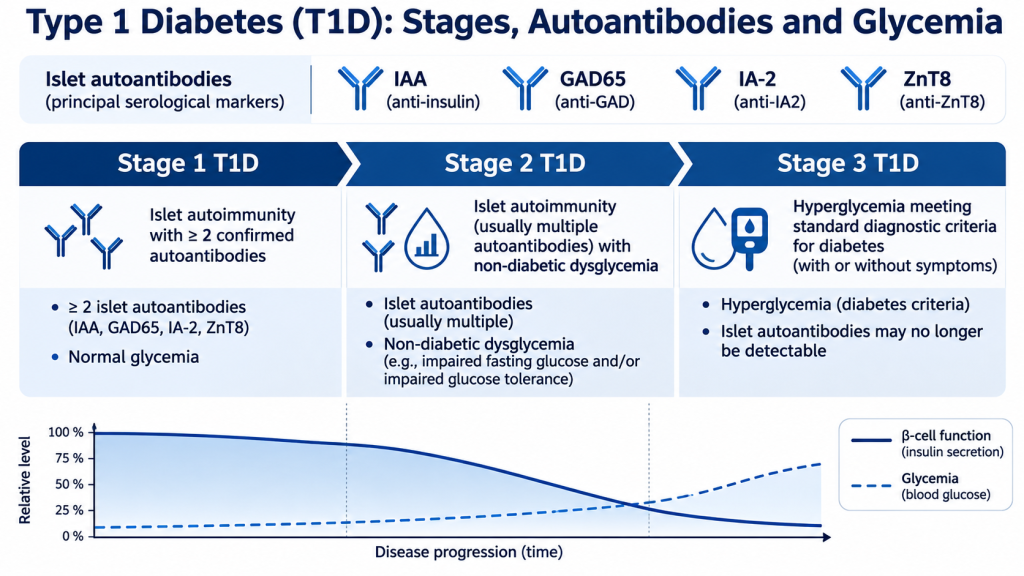
Adapted from Insel RA et al. (2015). Staging Presymptomatic Type 1 Diabetes: A Scientific Statement of JDRF, the Endocrine Society, and the American Diabetes Association. Illustration generated with AI.
Why screening should extend beyond family history
Restricting screening to high-risk persons, such as relatives of people with T1D, leaves many future cases unidentified, since most individuals who develop stage 3 type 1 diabetes do not have a prior family history of the disease. The consensus therefore recommends offering screening to the general population where healthcare policy and infrastructure support its implementation.
The clinical value depends on what follows detection. Identifying early-stage T1D allows education about symptoms, metabolic monitoring, and timely intervention, with less diabetic ketoacidosis at clinical diagnosis and a milder presentation. Early identification can also facilitate access to disease-modifying therapies or clinical trials.
For a broader discussion of how earlier detection and emerging interventions may reshape T1D care, see our article on this topic.
Begin with preschoolers and rescreen during childhood
The recommended schedule starts at ages 2–4 years, followed by rescreening at ages 6–8 and 10–15 years if previous results were negative. Children who have never been screened should enter the schedule at the earliest opportunity.
Repeat testing matters because a negative result describes antibody status at sampling and does not exclude subsequent development of islet autoimmunity3.
Choose an appropriate autoantibody panel
The four autoantibody specificities forming the basis of screening are IAA, anti-GAD, anti-IA2, and anti-ZnT8. The consensus recommends that initial screening detect at least three of these four markers, and confirmatory testing should distinguish all four specificities. For general population screening, the consensus recommends antigen-specific assays and reserves ICA immunofluorescence for research purposes.
Test selection should account for differences in the prognostic value and age-related prevalence of IAbs. For example, anti-IA2 positivity has a higher positive predictive value (PPV) for progression to stage 3 T1D than positivity for other islet autoantibodies4. The use of IAA and anti-GAD is likely to provide the highest sensitivity for the detection of early-stage type 1 diabetes in children, but IAA are less frequently detected in adults than in children5.
For laboratories, this implies a sensitive initial assay strategy, supported by more specific confirmatory testing. Assays must be validated for clinical use, with appropriate quality assurance and external proficiency assessment.
Confirm positive results before assigning a diagnosis
A positive screening result requires confirmation in a second blood sample. Ideally, confirmation should use a different assay method, because methods can differ in their susceptibility to false-positive signals. Confirmatory measurements should use serum or plasma obtained from venous blood. The preferred “rule of 2s” approach combines at least two positive autoantibody specificities, two assay methods, and two consecutive samples.
Interpretation and follow-up should account for the individual’s age and clinical context. Individuals with confirmed multiple IAbs should be referred for metabolic staging and a structured monitoring plan.
Research on islet autoimmunity also continues to extend to non-European populations, as illustrated by a study of people with clinically diagnosed T1D in Ghana6. Similarly, other research addresses coexisting autoimmune diseases, such as a study of young people with both T1D and celiac disease7.
For further information on serological testing in celiac disease, including the implications of IgA deficiency, see our article on celiac disease diagnostics.
Make screening part of a complete care pathway
The consensus supports integrating childhood autoantibody screening into preventive care, with reliable confirmation and ongoing support for those identified. Its implementation must reflect local disease prevalence, laboratory capacity, and access to specialist follow-up. For laboratory services, the priority is a coordinated pathway that connects accurate antibody detection with a clear clinical response. As the first country, Italy has established a legislative framework for a national pediatric screening program for T1D and celiac disease, highlighting the public health relevance of their early detection8.

Related products
Quantitative determination of antibodies against Glutamic Acid Decarboxylase (GAD65)
Quantitative determination of antibodies against Protein Tyrosine Phosphatase (IA2)
Quantitative determination of antibodies against Insulin (IAA)
Immunofluorescence Determination of IgG antibodies against islet cells (ICA)
Reference
- Ziegler et al., 2026, International consensus guidance for general population screening for islet autoantibodies to diagnose early-stage type 1 diabetes: a nominal group technique process ↩︎
- American Diabetes Association Professional Practice Committee for Diabetes., 2026, Diagnosis and Classification of Diabetes: Standards of Care in Diabetes—2026 ↩︎
- Winkler et al., 2026, Screening Children for Early-Stage Type 1 Diabetes ↩︎
- Sims et al., 2025, IA-2A positivity increases risk of progression within and across established stages of type 1 diabetes ↩︎
- Pauley et al., 2025, Prevalence of Islet Autoantibodies in Adults Without Diabetes ↩︎
- Aniagyei et al., 2026, Heterogeneity in clinically diagnosed type 1 diabetes: characterising a unique cohort with maintained C-peptide secretion in Ghana ↩︎
- Di Candia et al., 2026, Glucometabolic Control and Anti-Transglutaminase Antibodies at Celiac Disease Onset in Type 1 Diabetes Youth ↩︎
- Repubblica Italiana, 2023, Law 15 September 2023 n. 130, Disposizioni concernenti la definizione di un programma diagnostico per l’individuazione del diabete di tipo 1 e della celiachia nella popolazione pediatrica [in Italian] ↩︎