
86148 – ASA IFA
Highlights
- Slides coated with monkey esophagus tissue sections
- Screening test to support the diagnosis of autoimmune skin diseases
- Detects IgG antibodies against intercellular epithelial (ICS) and basement membrane (BM) antigens
- Ready-to-use reagents (except wash buffer)
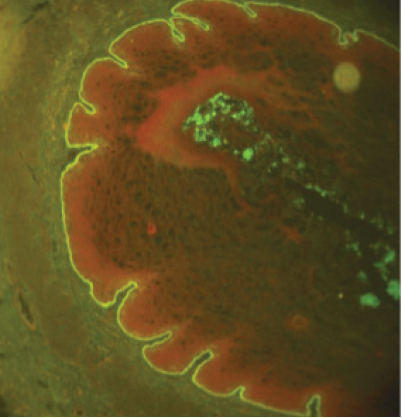
- Latticed fluorescence indicates pemphigus antibodies; linear BM fluorescence indicates bullous pemphigoid antibodies
- High diagnostic specificity and sensitivity
- Allows parallel processing of multiple samples
- CE marked
Intended Use
The ASA IFA is an immunofluorescence assay (IFA) for the qualitative and semi-quantitative determination of IgG antibodies in human serum against skin antigens on tissue sections of monkey esophagus. The ASA IFA is intended as an aid in the diagnosis of autoimmune skin diseases in conjunction with other clinical and laboratory findings. The immunoassay is designed for manual professional in vitro diagnostic use only.
Diagnostic Relevance
Blistering skin diseases represent a group of chronic, often progressive disorders caused primarily by autoimmune phenomena. Clinical differentiation relies on the combination of symptom presentation, histological findings, and the detection of disease-specific autoantibodies. The ASA IFA detects circulating IgG antibodies directed against intercellular epithelial antigens (ICS) such as desmoglein I and III, as well as hemidesmosomal components of basal keratinocytes in the epithelial basement membrane (BM).
In pemphigus, the assay identifies a characteristic latticed fluorescence pattern within the intercellular substance of the epithelium, which correlates with disease activity and decreases with successful therapy. ICS antibodies are highly specific markers, present in approximately 90% of affected patients and absent in healthy individuals.
Bullous pemphigoid, typically affecting people older than 60 years, is characterized by subepidermal blistering. The ASA IFA reveals linear fluorescence along the BM, corresponding to IgG antibodies targeting hemidesmosomes. These pathogenic antibodies directly contribute to clinical manifestations, and their detection supports an accurate diagnosis when combined with clinical examination and histopathology.
The use of monkey esophagus tissue sections provides a reliable and reproducible substrate for antibody detection, enabling both qualitative and semi-quantitative assessment. This approach allows early detection of autoimmune skin diseases, guiding timely intervention and monitoring therapeutic outcomes.
Product Specifications
| Title | ASA IFA |
| Product code | 86148 |
| Indication | Autoimmune skin diseases |
| Description | Indirect immunofluorescence assay for the qualitative and semi-quantitative determination of IgG antibodies in human serum against skin antigens |
| Format | Slides coated with cryostat tissue sections of monkey esophagus |
| Total incubation time | 60 min. |
| Sample volume | 20 µL serum |
| No. of determinations | 48 (12 x 4) |
Free downloads
SDS [REF 86148][eng] SDS [REF 86148][deu] Flyer [IFA Product Portfolio][eng]Restricted downloads - Password required
Current version of the instructions for use. The respective valid version for processing the test can be found in the product packaging.