
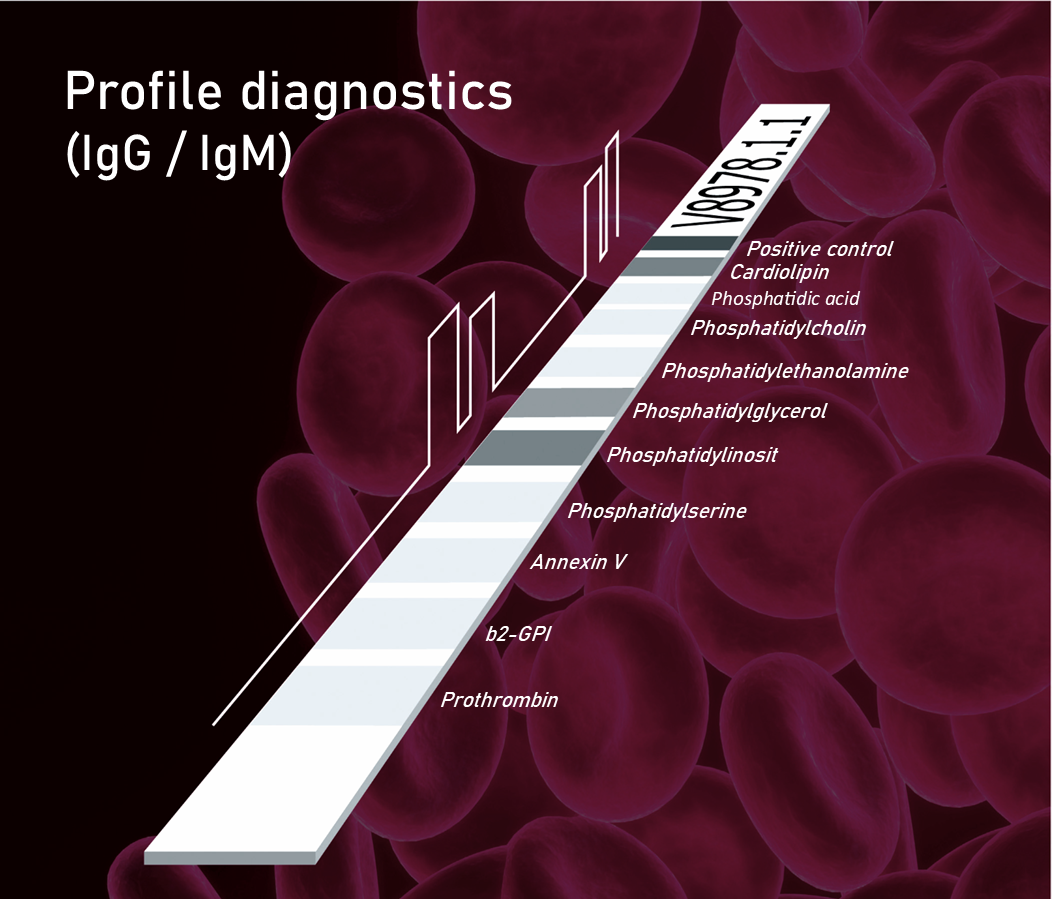
5012 – Anti-Phospholipid 10 Dot

Highlights
- Bestimmung von IgG-Antikörpern gegen IgG oder IgM-Antikörpern gegen Phospholipide und Serumproteine
- Line-Immunoassay für die gleichzeitige Untersuchung mehrerer Antigene
- Qualitätsgesicherte Handhabung in Routinelabors
- Gebrauchsfertige Teststreifen (Ausnahme: Puffer), farbige und mit Barcode versehene Reagenzien
- Hilft bei der Diagnose des Antiphospholipid-Antikörper-Syndroms (APAS) in Verbindung mit anderen klinischen und Laborbefunden
- Unterscheidet zwischen Antikörpern gegen Phospholipide und solchen, die den Cofaktor β2 GPI benötigen
- Hohe Präzision und Reproduzierbarkeit innerhalb des Messbereichs
- CE-gekennzeichnet
- Automatisierbar
Zweckbestimmung
Der Anti-Phospholipid 10 Dot ist ein qualitativer LINE Immunoblot zur Bestimmung von IgG oder IgM Antikörpern gegen Phospholipide und Serumproteine in humanem Serum. Er dient zur Unterstützung bei der Diagnose de Antiphospholipid Antikörper Syndroms (APAS) in Verbindung mit anderen klinischen und laboratoriumsmedizinischen Untersuchungen. Der Immunoassay ist für den manuellen professionellen in-vitro diagnostischen Gebrauch bestimmt.
Diagnostische Bedeutung
Das Antiphospholipid-Syndrom (APAS) ist eine Autoimmunerkrankung, die durch Thrombozytopenie, arterielle und venöse Thrombosen sowie wiederholte Schwangerschaftsverluste charakterisiert ist. Häufig tritt APAS gemeinsam mit systemischem Lupus erythematodes (SLE) auf. Zentral für die Erkrankung ist das Vorhandensein von Autoantikörpern, die negativ geladene Phospholipide erkennen.
Pathophysiologie und Zielantigene
Bei Patienten mit APAS binden Phospholipid-Antikörper bevorzugt an Phospholipide, die mit Plasmaprotein-Kofaktoren assoziiert sind, insbesondere β2-Glykoprotein-I (β2 GPI). Dieses Protein hat ein Molekulargewicht von etwa 50 kDa und beeinflusst die Thrombozytenaggregation sowie die Gerinnung. Die Interaktion von negativ geladenen Phospholipiden wie Cardiolipin mit der positiv geladenen fünften Domäne von β2 GPI verursacht Konformationsänderungen im Protein und führt zur Bildung neuer Epitope, die von Autoantikörpern erkannt werden.
Diagnostische Bedeutung der Anti-Phospholipid-Antikörper
Anti-Cardiolipin-Antikörper werden primär zur Diagnose von APAS herangezogen. Andere Antikörper gegen Phospholipide werden vor allem in der Differenzialdiagnose eingesetzt, speziell wenn Anti-Cardiolipin-Antikörper nicht nachweisbar sind. Der Nachweis dieser Autoantikörper ist entscheidend für die Bestätigung der Erkrankung, die Beurteilung des Thromboserisikos und die therapeutische Planung, da frühzeitige Interventionen wie Antikoagulation und Immuntherapie Komplikationen verhindern können.
Publikationen
- Emmenegger et al., (2023) Antiphospholipid antibodies are enriched post-acute COVID-19 but do not modulate the thrombotic risk
- Alijotas-Reig et al., (2023) Thrombosis and Hyperinflammation in COVID-19 Acute Phase Are Related to Anti-Ph.serine and Anti-Ph.inositol AbsPositivity
- Anunciación-Llunell et al., (2022) Differences in APS Abs Profile between Patients with Obstetric and Thrombotic APS
- Tkachenko et al., (2020) Profiling of non-criteria APS Abs in patients with SLE-differentiation of thrombotic SLE patients and risk of recurrence of thrombos
- Volkov et al., (2020) Profiles of criteria and non‑criteria APS Abs are associated with clinical phenotypes of the APS
- Park et al., (2019) Thrombotic Risk of Non-Criteria APL Measured by LIA_Superiority of aPS and aPA Abs
- Thaler et al., (2019) Evaluation of the sens. and spec. of a novel LIA for the detection of criteria and non-criteria APS Abs in comparison to established ELISAs
- Nalli et al., (2018) APS IgG Abs detected by LIA differentiate patients with APS and other autoimmune diseases
- Roggenbuck et al., (2016) Antiphospholipid antibodies detected by line immunoassay differentiate among patients with APS, with infections and asymptomatic carriers
- Egerer et al., (2011) Single-step autoAb profiling in APS using a multi-LIA
Produktspezifikationen
| Titel | Anti-Phospholipid 10 Dot |
| Produktcode | 5012 |
| Indikation | Anti-Phospholipid-Antikörper-Syndrom |
| Beschreibung | Line Immunoassay zur qualitativen Bestimmung von IgG oder IgM Antikörpern gegen Phospholipide und Serumproteine in humanem Serum |
| Format | Teststreifen beschichtet mit Cardiolipin, Phosphatidsäure, Phosphatidylcholin, -Ethanolamin, -Glycerin, -Insitol, -Serin, Annexin V, β2-Glykoprotein I und Prothrombin |
| Gesamte Inkubationszeit | 55 min. |
| Probenvolumen | 30 µL Serum |
| Anzahl der Bestimmungen | 20 x 10 |
Öffentliche Downloads
Flyer [Anti-Phospholipids][eng] Flyer [Anti-Phospholipids][deu] Flyer [Anti-Phospholipids][esp] SDS [REF 5012][eng] SDS [REF 5012][deu]Geschützte Downloads - Kennwort erforderlich
Aktuelle Version der Gebrauchsanweisung. Die jeweils gültige Version für die Testdurchführung finden Sie in der Produktverpackung.